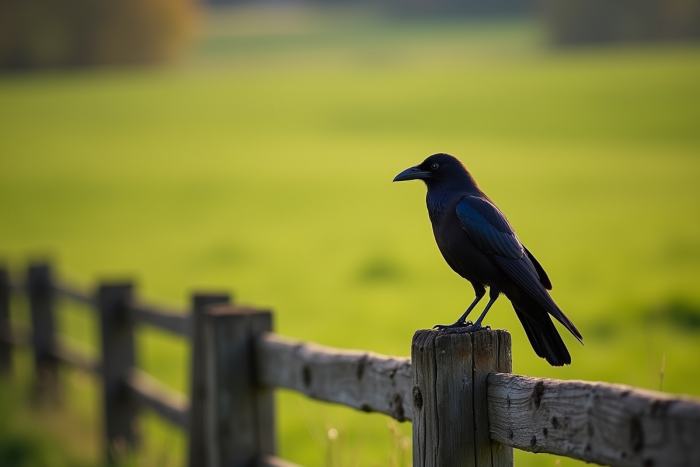
The raven, often perceived as a dark omen or a symbol of mystery, hides many fascinating secrets. This bird, which is part of the corvid family, possesses remarkable intelligence, rivaling even that of great apes. Its ability to use tools, solve complex problems, and even recognize human faces places it among the most intriguing creatures in the animal kingdom.
In addition to its intellect, the raven has a rich and complex social life. Capable of forming alliances and showing emotions such as joy or sadness, it challenges preconceived notions about birds. Its song, much more varied than mere cawing, can mimic sounds from the environment, adding an extra dimension to its mystery.
Unknown facts about raven behavior
Ravens, often associated with crows, reveal astonishing behaviors that Austrian researchers employed by the University of Vienna have highlighted. These birds do not always fly in a straight line, demonstrating remarkable adaptability. They also take ant baths to rid themselves of parasites, a practice called ‘anting’.
The female raven, just like the male, participates in gatherings during winter, forming large groups to better survive harsh conditions. With a lifespan of 40 years, these birds adapt to all types of environments, both urban and rural.
| Behaviors | Details |
|---|---|
| Tool use | The New Caledonian raven makes hooks to catch food |
| Memory | They remember the face of an unreliable person and prefer to collaborate with trustworthy individuals |
| Communication | They use accents and employ regional dialects |
The cognitive abilities of ravens are impressive. They solve complicated puzzles and hide food for later, demonstrating advanced planning. Their highly varied diet allows them to adapt to different habitats, and they form lifelong pairs, although they are only socially monogamous.
The scientific journal ‘Animal Behaviour’ published the results of a study conducted by experimenters who exchanged food with ravens. This research revealed that ravens remember the faces of cheaters a month after the interaction, demonstrating exceptional memory. 
The raven in culture and legends
Far from being just a black bird with a harsh cry, the raven occupies a central place in various mythologies and legends. In Norse mythology, the ravens Hugin and Munin serve as messengers to the god Odin, symbolizing thought and memory. Their presence underscores the importance placed on reflection and wisdom in this culture.
In Aboriginal culture, the raven is a key character in creation stories. It is often depicted as a trickster, bringing fire to humans, but also introducing chaos and transformation.
- Guillaume Count of Poitiers inaugurated love poetry, where the raven often appears as a symbol of fidelity and mystery.
- Perceval, a character from the Grail Story, encounters the raven as a sign of fate, guiding knights towards epic quests.
Ravens also appear in the literary works of poets such as Louis Aragon and Guido Cavalcanti. Their black feathers and harsh cry have inspired metaphors about melancholy and premonition.
Even Saint Francis of Assisi, known for speaking to birds, included the raven in his interactions, highlighting diversity and inclusion in nature. Chaucer, in his writings, uses the raven to evoke themes of transformation and mystery.
The raven, beyond its appearance, embodies deep qualities and symbols, transcending cultures and eras with an aura of mystery and respect.