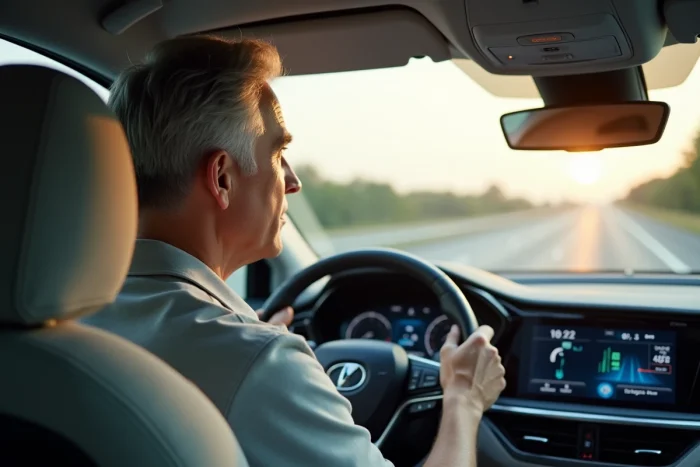
On the highway, a hybrid vehicle operates under a very different logic than what earns it a reputation in the city. The thermal engine takes over at stabilized speeds, and the battery only intervenes intermittently. Understanding this mechanical shift allows for adjustments in driving to reduce fuel consumption, even on long high-speed trips.
Why the electric motor fades on the highway
Most recent hybrids deactivate or limit the 100% electric mode beyond 110-120 km/h. Toyota explains that its hybrids prioritize the thermal engine at sustained speeds, with the electric motor only providing occasional support to limit consumption spikes. At Hyundai and Kia, recent manuals specify that the EV mode is unavailable or restricted beyond a defined speed.
This operation has a direct consequence: attempting to force the electric mode on the highway drains the battery without any real gain. The onboard management system automatically switches to parallel hybrid mode, where both engines cooperate according to the demand. Those exploring the tips for hybrid driving on the highway will find this fundamental principle: allowing the electronics to arbitrate between thermal and electric yields better results than manual intervention.
For plug-in hybrids (PHEVs), the situation is comparable. A report from the ICCT published in 2023 highlights a real fuel consumption three to five times higher than the WLTP homologated values when trips are predominantly fast or when the battery is not regularly recharged.
Stabilized speed and battery management: the two concrete levers
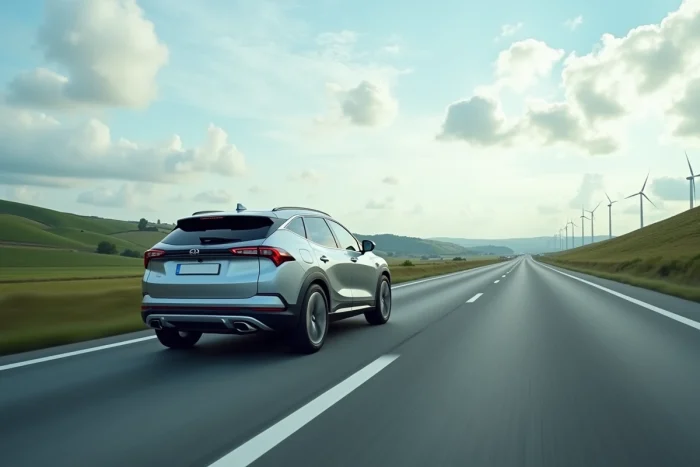
The first lever is maintaining a consistent speed. Each sudden acceleration puts pressure on the thermal engine in a high RPM range, where consumption increases. Using cruise control on the highway helps keep the thermal engine within its optimal efficiency range.
The second lever concerns managing the remaining charge. On a PHEV, keeping a battery reserve for deceleration segments or urban entries after exiting the highway reduces the overall consumption of the trip. Draining the battery within the first kilometers on the highway, then running purely on thermal for the rest of the journey, negates the hybrid advantage.
Regeneration during braking on the highway
Energy recovery during braking is less effective at constant speed than in the city, where stops are frequent. On the highway, deceleration phases are limited to exits, occasional slowdowns, and downhill stretches. Anticipating slowdowns by easing off the accelerator early extends the recovery phase and partially recharges the battery.
Some models offer paddles on the steering wheel or a reinforced regeneration mode. Activating this mode before a highway exit or toll area converts kinetic energy into stored electricity rather than heat lost in the brakes.
Real consumption of hybrids on the highway: what the WLTP shows
The WLTP homologation cycle includes an “extra-urban” phase, but this does not replicate a sustained highway journey. The average speeds of the cycle remain below actual conditions on French motorways. The result: the gap between homologated consumption and observed consumption widens significantly as the proportion of highway driving increases.
The European Commission and several countries (including Germany and the Netherlands) have tightened the eligibility conditions for PHEVs to receive tax benefits, partly due to this drift. In France, the ecological bonus for plug-in hybrids has also been removed, indicating that authorities consider the real environmental benefit insufficient on fast roads.
This technical reality does not disqualify hybrids on the highway. It emphasizes the need to understand that consumption gains primarily depend on driving behavior and recharge management, not just the onboard technology.
Tires, air conditioning, and weight: often neglected loss factors
Rolling resistance weighs more heavily at high speeds than in the city. Three factors deserve specific attention before a highway trip in a hybrid:
- The pressure of the tires should be checked when cold and adjusted to the level recommended by the manufacturer (often slightly higher for hybrids due to the additional weight of the battery). Under-inflation increases rolling resistance and fuel consumption.
- Air conditioning consumes electrical energy that will no longer be available to assist the thermal engine. Reducing the set temperature or using ventilation without the compressor during mild conditions decreases battery demand.
- The carried weight has a proportionally greater effect on a hybrid than on a conventional thermal vehicle, as each additional kilogram reduces electric range. Removing unnecessary items from the trunk and avoiding roof boxes (which also increase aerodynamic drag) helps limit overall consumption.
These adjustments do not transform a hybrid into a fuel-efficient vehicle on the highway. They reduce parasitic losses that prevent the hybrid system from operating at its best capacity.
The real gain of a hybrid on the highway remains modest compared to city driving or secondary roads. The goal is not to replicate urban performance, but to limit the overconsumption typical of fast trips. A stabilized speed, intelligently managed battery, and properly prepared vehicle are the only reliable levers to achieve this.