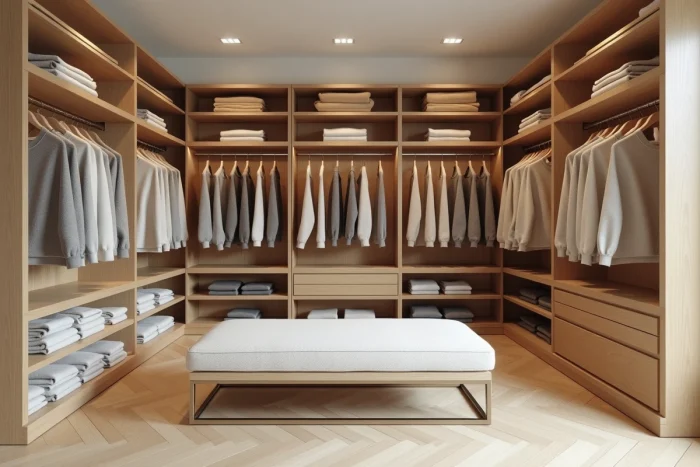
Between closed facades and vertical configurations, the dressing room of 2026 no longer resembles that of five years ago. Plans are evolving, materials are changing, and the way space is utilized is also different. Which layouts are gaining ground, and on what criteria should they be judged when the available area varies from simple to triple?
Closed or open dressing: how configurations change daily life
The 2026 trend clearly leans towards less exposed storage. Sliding facades and flush doors replace visible shelves, in contrast to the “showroom” dressing room popularized in the previous decade.
This choice is not just aesthetic. A closed dressing room reduces dust accumulation and visual noise in the bedroom. It also simplifies maintenance, as the contents remain hidden even when the interior storage is not perfect.
| Criterion | Open dressing (visible shelves) | Closed dressing (facades / sliding doors) |
|---|---|---|
| Maintenance | Frequent (dust on clothes) | Reduced (protected contents) |
| Sense of space | Airier in large rooms | Neater in small spaces |
| Average budget | More accessible (less hardware) | Higher (rails, facades, finishes) |
| Acoustic comfort | No contribution | Slight sound attenuation |
| Adaptability to disorder | Low (everything is visible) | High (everything is hidden) |
Acoustic comfort, rarely mentioned, is nonetheless an emerging angle. In a bedroom adjacent to a hallway or bathroom, solid wood or thick panel facades create a buffer zone that dampens passing noises. To delve deeper into plans and visual layouts, Murmures Déco’s decor tips detail several schemes suitable for contemporary bedrooms.
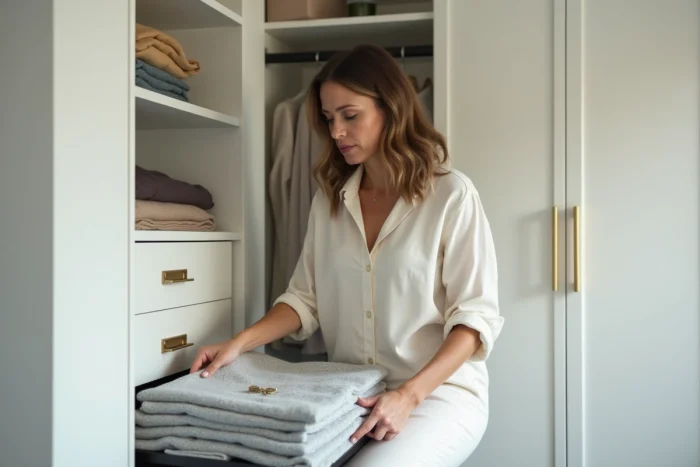
Vertical optimization of the dressing room: utilizing ceiling height
Small space solutions are becoming more specialized in 2026. Optimization now focuses not only on floor space but on fully utilizing the available height, from floor to ceiling.
Specifically, this involves stacked rods on two levels: one at a standard height for everyday clothes, and another higher up for off-season items. The upper modules remain accessible via pull-downs or integrated step stools.
Lost corners and sloped nooks
L-shaped or U-shaped dressings, designed for room corners or attics, allow for the recovery of unused areas. A nook less than a meter deep can accommodate shoe storage, low drawers, or accessory bins.
- High rod (above 1.80 m): coats, seasonal jackets, rarely worn clothes. Plan for a pull-down system or a discreet step stool.
- Middle zone (between 0.90 m and 1.80 m): hanging everyday clothes, shelves for folded sweaters, integrated laundry baskets.
- Low zone (below 0.90 m): shoe drawers, storage bins, sliding modules for accessories.
A well-zoned compact dressing room in three levels offers as much capacity as a classic closet twice its width. The key lies in the height of the modules, not in the floor space.
Dressing room as a transition zone: rethinking the bedroom layout
The dressing room of 2026 no longer functions as a standalone room. It integrates as a hybrid space between the bedroom and the bathroom, a transition zone that structures circulation in the sleeping area.
This positioning changes the logic of the layout. Instead of a dressing room attached to a wall of the bedroom, several recent layouts place it across: you pass through the dressing room to access the bathroom. The bedroom remains clear, and the morning routine follows a linear path.
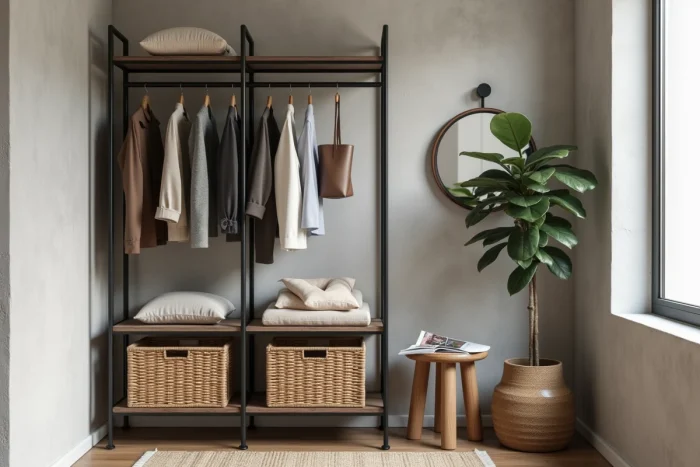
Integrated lighting and ambiance
Lighting contributes to this transition function. Recessed LEDs under shelves or in facade rails create a soft light, distinct from the main lighting of the bedroom. Motion-detection lighting avoids turning on the entire room when getting ready early in the morning.
This approach aligns with the overall trend of segmenting lighting atmospheres by zone rather than by room. The dressing room becomes a vestibule, not a closet.
Materials and dressing facades in 2026: wood, caning, and matte finishes
Wood remains the dominant material in contemporary dressings, but its treatment is evolving. Matte finishes and light shades (bleached oak, natural birch) prevail, in line with the search for serenity in the sleeping space.
- Solid wood or veneer: superior durability, visible grain, higher budget. Suitable for sliding door facades and main shelves.
- Textured melamine panels: favorable quality/price ratio, wide choice of wood decors. Suitable for interior fittings (dividers, niche backs).
- Caning and rattan inserts: add texture and natural ventilation to facades. Mainly reserved for small module doors or laundry drawers.
- Matte black metal (rods, handles, frames): used in occasional touches to visually structure without weighing down.
Smooth facades with no visible handles are gaining ground. The push-to-open system or integrated grooves replace knobs and bars, reinforcing the “invisible” aspect of the dressing room integrated into the bedroom.
In contrast to previous trends that multiplied contrasts, the 2026 palette plays on close tones: beige, greige, off-white, light wood. The dressing room blends into the wall rather than standing out.
The choice of layout, level of closure, and materials primarily depends on the actual surface area and the position of the dressing room relative to the bathroom. A cross layout with closed facades and vertical optimization covers the majority of current configurations, including in apartments where the bedroom does not exceed ten square meters.