
The FoodSaver V2860 removes air from bags and containers to extend food preservation. However, between the heating sealing strip, the risk of obstruction with liquids, and accelerated wear in certain environments, daily use of this vacuum machine requires more diligence than just pressing a button. What parameters should be monitored to keep the device reliable over time, and what maintenance actions truly make a difference?
FoodSaver V2860 and Liquid Suction: A Measurable Weakness
The V2860 works very well with dry foods, blanched vegetables, or meat bags. However, as soon as a liquid comes into play (marinades, sauces, moist foods), the machine shows its limits.
According to a comparative test published by Which? magazine in January 2026, the V2860 has less effective suction on liquids than competing models like the Anova Precision, with a tendency for more frequent obstruction during intensive use. This finding directly informs the precautions to take on a daily basis.
| Criterion | FoodSaver V2860 | Type Competitor (Anova Precision) |
|---|---|---|
| Suction on dry foods | Effective | Effective |
| Suction on liquids | Frequent obstruction | More reliable management |
| Risk in intensive use | High without regular maintenance | Moderate |
| Post-use maintenance for wet items | Systematic cleaning required | Recommended cleaning |
To limit obstructions, freeze liquids before vacuum sealing, or use the manual stop function just before the liquid reaches the sealing area. You can consult the FoodSaver V2860 guide to precisely identify the positioning of the bag in the suction channel and avoid juice backflow.
Maintenance of the FoodSaver V2860 in a Humid Tropical Climate
High ambient humidity (beyond 70 to 80% constant humidity) alters the behavior of several internal components of the V2860. The sealing strip, sealing gaskets, and suction mechanism are the first to be affected.
Condensation and Sealing Strip
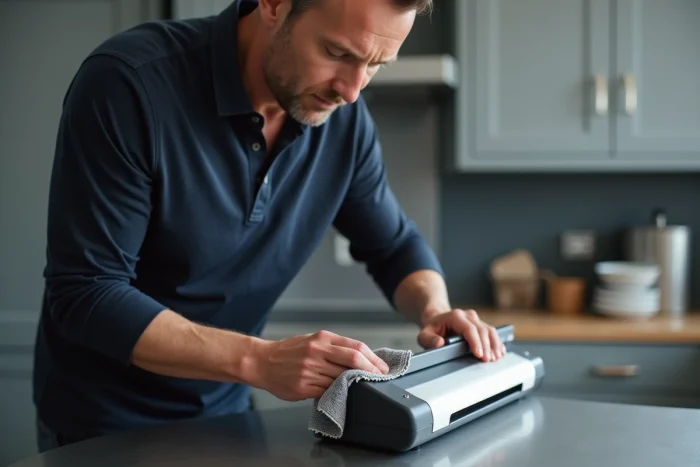
In a tropical climate, condensation forms more quickly on the sealing strip between two cycles. A film of moisture on this strip prevents proper sealing, resulting in poorly sealed bags. Always wait for the strip to cool down and dry it with a clean cloth before each new cycle.
The manual reminds that the sealing strip heats up significantly during the process. In a humid environment, this thermal differential exacerbates condensation. Two to three minutes of pause between each bag is sufficient to prevent the accumulation of residual moisture.
Gaskets and Suction Mechanism
Humidity promotes the development of mold on the silicone gaskets of the suction channel. Weekly cleaning of the gaskets with a cloth soaked in warm water is the minimum in a tropical area.
Feedback from professional users in collective catering, shared on the ChefsUnderPressure forum in April 2026, indicates that diluted white vinegar rinsing after each wet use extends the device’s lifespan by about 30%. This simple action neutralizes organic residues before they colonize the internal parts.
- Wipe the sealing strip and suction channel after each use, especially if you have vacuum sealed moist foods.
- Store the device in a ventilated area, with the lid open, to prevent moisture from getting trapped inside.
- Check the silicone gaskets every month and replace them as soon as they show signs of deformation or darkening.
Mandatory Cleaning of Internal Circuits: European Regulation 2026
Since January 2026, the European regulation EU 2026/1042 mandates mandatory cleaning of the internal circuits of vacuum machines every six months to prevent bacterial proliferation. This obligation, published in the Official Journal of the EU on February 15, 2026, has not yet been integrated into current FoodSaver manuals.
For the V2860, this involves disassembling the liquid collection tray (located under the lid), washing it with soapy hot water, and wiping a damp cloth in the suction channel. If you use the machine several times a week, quarterly cleaning is more suitable than the minimum regulatory semi-annual requirement.
This regulation applies to both domestic and professional devices. No home inspection is planned, but in the event of a health issue related to vacuum packaging, the owner’s liability may be engaged if maintenance has not been performed.

FoodSaver Bags and Food Preservation: Common Mistakes
The V2860 works with cut or pre-cut FoodSaver bags. The quality of the vacuum sealing depends as much on the preparation of the bag as on the machine itself.
The first common mistake: not leaving enough space between the contents and the sealing area. Allow at least five centimeters of margin at the top of the bag. Food residues on the sealing area prevent airtight sealing.
The second trap: reusing a previously sealed bag without checking its integrity. A micro-hole is enough to let air in and nullify the preservation effect. A reused bag must be recut above the first seal to ensure a clean and intact surface.
- Always cut the bag with clean, straight scissors to ensure the seal is uniform across the entire width.
- For foods with sharp edges or protruding bones (fish, ribs), double the bag or insert a protective paper to avoid punctures.
- Label each bag with the vacuum sealing date, as preservation is not unlimited even without air.
The FoodSaver V2860 remains a reliable device for regular home use, provided you respect its limits with liquids and maintain appropriate care for your environment. In humid areas, drying and post-use cleaning actions are not optional; they directly condition the longevity of the machine and the food safety of your packaging.