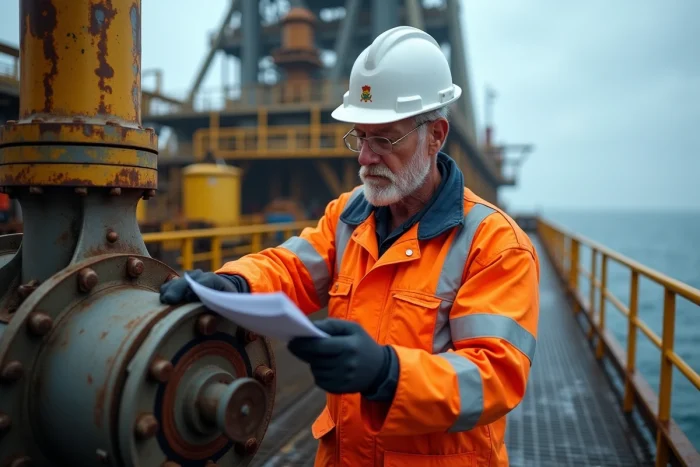
On an offshore oil platform, several hundred people coexist for weeks, in rotation. Each occupies a specific position, with responsibilities ranging from well management to collective cooking. The jobs on a Total oil platform cover a much broader range than one might imagine from dry land.
Offshore Predictive Maintenance: The Digital Shift Redefining Roles
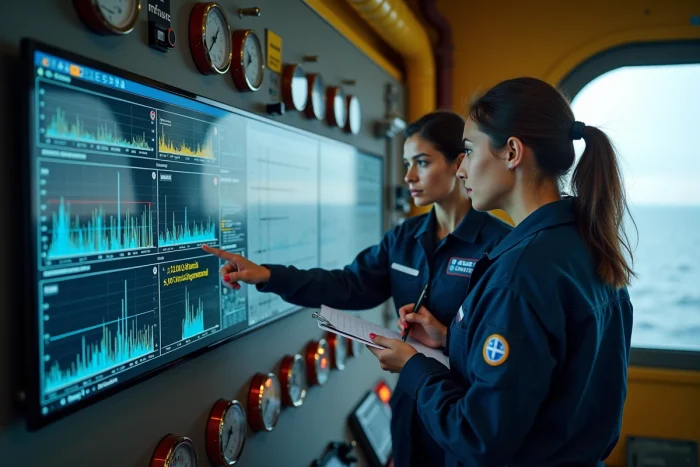
In recent years, offshore operators have accelerated the deployment of connected sensors, remote inspection, and analytical tools directly on the installations. TotalEnergies’ 2025 universal report details this digitalization of offshore operations.
Specifically, a maintenance technician no longer inspects equipment “blindly.” He receives a diagnosis prepared remotely, with vibration, temperature, or pressure data already analyzed. His intervention is targeted even before he puts on his protective gear.
This change also affects planners. Technical shutdowns, once scheduled according to a fixed calendar, are now triggered by the actual condition of the machines. Fewer unplanned interventions, more preparation in advance: the daily life of the onboard teams is transformed. A complete overview allows for a better understanding of the jobs on a Total oil platform and how each position adapts to these changes.
Embedded Technical Profiles: Who Does What on an Oil Platform
You might imagine a team composed solely of drilling engineers. The reality is more diverse. Here are the main job families found on board.
- Production Operators: they monitor the flow of oil and gas, adjust valves, and control separators. Their role is to maintain production within defined safety parameters.
- Maintenance Technicians (mechanical, electrical, instrumentation): they ensure the proper functioning of rotating equipment, electrical systems, and sensors. With the rise of digital technology, their work now includes reading predictive data.
- Drilling Team: from the site manager to the roughneck (floor worker), this team manages the well. The driller operates the drill string, while the mudman (mud engineer) adjusts the composition of drilling fluids to stabilize the well.
- HSE Personnel (health, safety, environment): these professionals ensure that every operation complies with procedures. They lead daily safety briefings and intervene in case of an incident.
- Support Functions: onboard doctor or nurse, cook, helicopter logistics coordinator. In an isolated offshore installation, these positions are as critical as technical roles.
Each rotation generally lasts several weeks, followed by an equivalent rest period on land. This rhythm structures the professional and personal life of all onboard.
Regulatory Pressure and Safety: What Structures Each Workday
On an offshore platform, safety is not just another topic. It is the framework within which all tasks are performed. The recent trend in Europe and comparable regulated areas is towards strengthening obligations to prevent major accidents.
This translates into very concrete constraints. Before each operation, a work permit is issued. This document details the identified risks, protective measures, and necessary validations. No intervention starts without a signed work permit.
The management of subcontractors is also subject to enhanced monitoring. External teams (specialized welders, divers, inspection technicians) are integrated into the same traceability system as permanent staff. Every critical action is documented.
The Central Role of the Offshore HSE Manager
The HSE manager does not merely write reports. He is present on the ground, observes operations, and corrects deviations in real-time. His day begins with a site tour and ends with a debriefing with team leaders.
A procedural deviation detected in the morning can alter the organization of the afternoon. This responsiveness is a direct result of regulatory pressure, which demands near-total traceability of critical operations.
Offshore Decommissioning: A New Skill Set for Teams
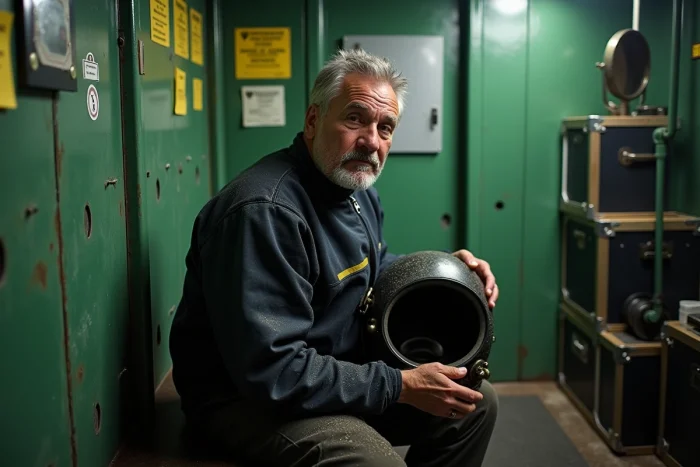
On the oldest installations, a reality is emerging: teams are no longer just working to produce. They must also prepare for the partial or total decommissioning of the platform.
This topic changes the very nature of missions. A structural engineer who, yesterday, calculated reinforcements to extend the lifespan of a module, today evaluates cutting and removal methods for that same module. Production and decommissioning coexist on the same site, sometimes in adjacent areas.
The required skills are evolving accordingly. Knowledge of materials, their corrosion state after decades at sea, and heavy lifting techniques becomes a sought-after asset. Profiles capable of managing this dual mission, producing while preparing for end-of-life, are gaining value in the offshore job market.
Energy Transition and Skill Reconversion
Several operators, including TotalEnergies, are repositioning part of their offshore skills towards marine renewable energies (offshore wind, for example). Technicians trained in maintenance in hostile environments, accustomed to rotations and strict safety constraints, have a directly transferable skill set.
This bridge between offshore oil and marine energies represents a concrete outlet for professionals in the sector. The skills acquired on an oil platform do not end with the closure of an oil field.
Working on an offshore platform remains a unique professional experience, marked by isolation, the rigor of procedures, and the interdependence between jobs. The rise of digital technology, tightening regulations, and the emergence of decommissioning are reshaping these roles year after year, without erasing what characterizes them: an environment where every mistake has immediate consequences, and where technical competence is measured daily.