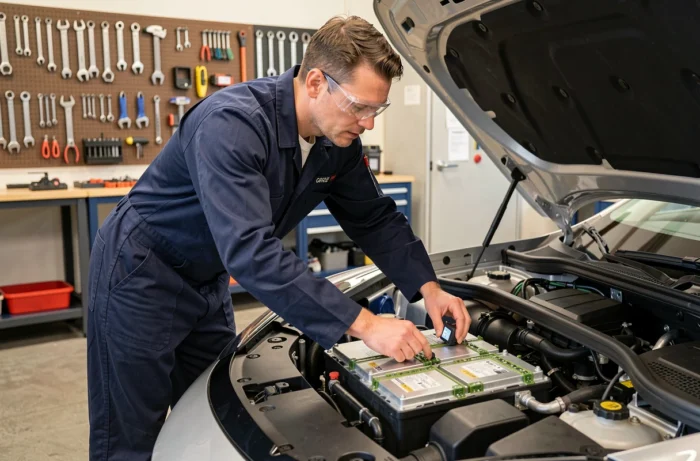
Vehicles sold today contain more lines of code than a commercial airliner. This reality is changing the very nature of automotive repair, from the skills required in the workshop to the rules governing repairs and parts distribution. Three major shifts are reshaping the industry right now: the battle over vehicle data, post-sale cybersecurity requirements, and the restructuring of Europe’s battery value chain.
Vehicle data and access to repairs: a regulatory tug-of-war
Have you ever noticed that your independent mechanic can’t always access the same information about your car as an authorized dealership? That’s no coincidence. Modern vehicles continuously generate streams of data, including brake wear, battery condition and engine alerts. The manufacturer centralizes this information and decides who can access it.
The European Commission has assessed the automotive block exemption regulation governing repairs and the distribution of spare parts. The main issue is independent access to data generated by vehicles. Without this access, independent repair shops lose the ability to diagnose certain faults, reducing competition in the aftermarket.
One point rarely discussed in mainstream media concerns the right to repair. According to a legal analysis published by the law firm Adaltys in October 2026, this right does not apply to cars in the same way as it does to other consumer goods. The automotive sector’s technical and regulatory requirements create a distinct framework, with different obligations for manufacturers.
By following the latest news from Actu Mécanique, it becomes clear just how much this issue now shapes debates between manufacturers, suppliers and independent repairers.

Automotive cybersecurity: obligations that continue beyond the factory gates
We often think vehicle safety is determined at the design stage. When it comes to software, that’s not true. UN Regulations R155 and R156 impose two distinct requirements on manufacturers:
- R155 governs cybersecurity management throughout the vehicle’s life cycle, not just during design or type approval.
- R156 covers over-the-air software updates. Manufacturers must ensure that each update introduces no vulnerabilities and remains traceable.
Why does this matter for day-to-day automotive repair? Because workshops servicing electronic systems must comply with these protocols. Connecting a third-party diagnostic tool to a connected vehicle is no longer a trivial matter. Improper handling can compromise the vehicle’s software integrity and make the repairer liable.
This post-sale monitoring requirement is transforming the relationship between manufacturers and repair networks. Whether they like it or not, mechanics are becoming part of the cybersecurity chain.
A new standard for software traceability
The OpenChain framework, already used in the open-source software industry, is expanding into the automotive sector with a dedicated standard for software bills of materials (SBOMs). The goal is to let every player in the supply chain know exactly which software components are running in a vehicle and which licenses apply to them.
Every embedded software component must be identifiable and traceable. For automotive professionals, this means diagnostic tools will gradually incorporate this layer of information, making repairs better documented but also more tightly regulated.
Electric vehicle batteries in Europe: an industrial supply chain that remains fragile
Vehicle electrification has been making headlines for years. What gets less attention is the actual state of battery production in Europe.
Demand for electric vehicles is growing, but producing batteries in Europe remains a tangible industrial challenge. The value chain is geographically concentrated in a handful of countries and fragmented across the industry. Raw material extraction, refining, cell manufacturing and pack assembly do not all take place in the same location.
This fragmentation has a direct impact on the parts and used-car markets. If a battery pack needs replacing, availability and cost depend on a supply chain that is not yet mature. For automotive professionals, this means variable lead times and training specific to each cell technology.
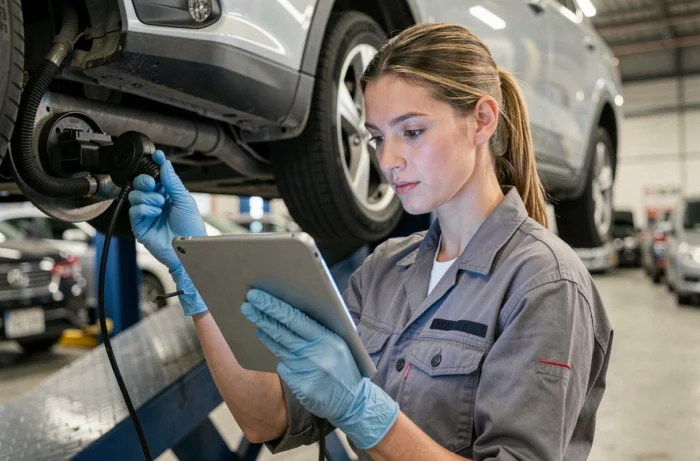
Hybrid and electric vehicles: two different approaches to maintenance
A hybrid vehicle retains an internal combustion engine and its usual maintenance requirements, such as oil changes, timing belt servicing and exhaust repairs, while adding a high-voltage system. Technicians must be proficient in both areas. An electric model eliminates the combustion engine but introduces strict safety protocols for handling voltages of several hundred volts.
The skills required vary depending on the powertrain, and a workshop looking to service the entire vehicle fleet must invest in separate certifications. This is a particular burden for small independent businesses.
Technological innovations and their impact on the used-car market
Advanced driver-assistance systems (ADAS), over-the-air software updates and always-on connectivity are changing how used vehicles are assessed. A model that no longer receives software updates becomes less appealing, even if its mechanical condition is sound.
Used-car buyers are beginning to factor this in. A connected vehicle whose manufacturer still guarantees updates holds its value better than a model that has been abandoned from a software perspective. Software support duration is becoming a factor in depreciation, alongside mileage and bodywork condition.
The automotive industry is entering a phase in which mechanical condition alone is no longer enough to define a vehicle’s overall state. Data, software and regulations matter just as much as physical wear. For professionals and private buyers alike, understanding these changes helps anticipate ownership costs and make more informed purchasing decisions.